Influence the Church Have Over Art in the Middle Ages
Religious practice in medieval Europe (c. 476-1500) was dominated and informed by the Catholic Church. The majority of the population was Christian, and "Christian" at this time meant "Catholic" every bit there was initially no other form of that religion. The rampant corruption of the medieval Church, even so, gave rise to reformers such as John Wycliffe (l. 1330-1384) and Jan Hus (l. c. 1369-1415) and religious sects, condemned as heresies by the Church building, such as the Bogomils and Cathars, amongst many others. Even so, the Church maintained its power and exercised enormous influence over people's daily lives from the king on his throne to the peasant in the field.
The Church building regulated and defined an individual's life, literally, from birth to expiry and was thought to continue its hold over the person'southward soul in the afterlife. The Church building was the manifestation of God's will and presence on earth, and its dictates were not to be questioned, fifty-fifty when it was credible that many of the clergy were working far more than steadily toward their own interests than those of their god.
A dramatic blow to the power of the Church building came in the form of the Black Death pandemic of 1347-1352 during which people began to doubt the power of the clergy who could practise zero to finish people from dying or the plague from spreading. Notwithstanding, the Church repeatedly crushed dissent, silenced reformers, and massacred heretical sects until the Protestant Reformation (1517-1648) which broke the Church building's power and allowed for greater liberty of thought and religious expression.
Church Structure & Behavior
The Church claimed authority from God through Jesus Christ who, according to the Bible, designated his apostle Peter equally "the stone upon which my church will exist congenital" to whom he gave the keys of the kingdom of sky (Matthew xvi:eighteen-xix). Peter was therefore regarded as the first Pope, the head of the church, and all others equally his successors endowed with the same divine authority.
By the time of the Middle Ages, the Church had an established hierarchy:
- Pope – the head of the Church building
- Cardinals – advisors to the Pope; administrators of the Church
- Bishops/Archbishops – ecclesiastical superiors over a cathedral or region
- Priests – ecclesiastical authorities over a parish, village, or boondocks church
- Monastic Orders – religious adherents in monasteries supervised by an abbot/abbess
The Church maintained the belief that Jesus Christ was the only begotten son of the ane true God as revealed in the Hebrew scriptures and that those works (which would become the Christian Old Testament) prophesied Christ's coming. The appointment of the earth and history of humanity was all revealed through the scriptures which made up the Christian Bible – considered the word of God and the oldest book in the world – which was consulted every bit a handbook on how to live according to divine will and gain everlasting life in heaven upon i'due south death.
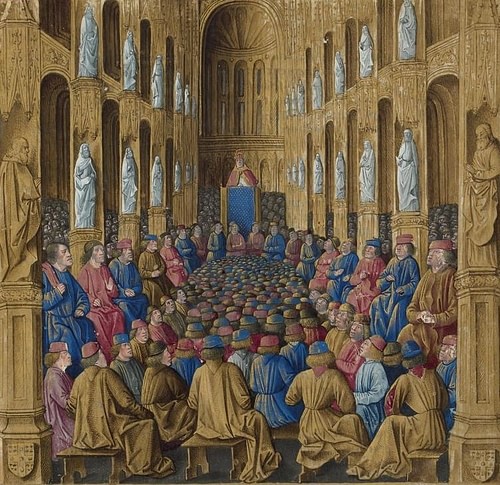
Urban II at the Council of Clermont
Interpretation of the Bible, however, was as well great a responsibility for the average person, and so the clergy was a spiritual necessity. In order to talk to God or understand the Bible correctly, one relied on one's priest as that priest was ordained by his superior who was, in turn, ordained past another, all under the authority of the Pope, God'due south representative on earth.
The Church hierarchy maintained the social hierarchy. One was born into a sure class, followed the profession of 1's parents, and died as they had. Social mobility was extremely rare to nonexistent since the Church taught that information technology was God's will one had been born into a certain ready of circumstances and attempting to meliorate ane'due south lot was tantamount to claiming God had made a mistake. People, therefore, accepted their lot and made the all-time of it.
Church building in Daily Life
The lives of the people of the Middle Ages revolved around the Church building. People, especially women, were known to nourish church three to five times daily for prayer and at least once a week for services, confession, and acts of contrition for repentance. The Church paid no taxes and was supported by the people of a town or urban center. Citizens were responsible for supporting the parish priest and Church overall through a tithe of 10 percent of their income. Tithes paid for baptism ceremonies, confirmations, and funerals as well equally saint's mean solar day festivals and holy solar day festivals such as Easter celebrations.
The teachings of the Church were a certainty to the people of the Middle Ages. There was no room for uncertainty & questions were non tolerated.
The center of a congregation's life in a modest-town church or city cathedral was not the altar but the baptismal font. This was a gratis-standing rock receptacle/basin used for infant or adult baptism – often quite big and deep – which also served to determine a person's guilt or innocence when i was charged with a crime. To clear one'south name, a person would submit to an ordeal in which one was bound and dropped into the font. If the accused floated, it was a articulate indication of guilt; if the accused sank, it meant innocence simply the accused would often drown.
Under the reign of the English language king Athelstan (r. 924-939), the process for the ordeal was codified as constabulary:
If anyone pledges to undergo the ordeal, he is and so to come up three days before to the mass-priest whose duty information technology is to consecrate it [the ordeal], and live off staff of life and water and salt and vegetables until he shall go to it, and be present at mass on each of those iii days, and make his offering and go to communion on the day on which he shall go to the ordeal, and swear then the oath that he is guiltless of that accuse according to the common law, before he goes to the ordeal. (Brooke, 107)
In that location was also the ordeal of iron in which the accused was forced to concord or bear a hot poker. If the person could hold the ruby-hot fe without called-for and blistering their easily, they were innocent; there are no records of anyone being found innocent. The ordeal of h2o was also carried out by streams, rivers, and lakes. Women defendant of witchcraft, for example, were often tied in a sack with their cat (thought to be their demonic familiar) and thrown into a torso of water. If they managed to escape and come up to the surface, they were constitute guilty and then executed, but they nigh often drowned.
Ordeals, like executions, were a form of public amusement and, as with festivals, marriages, and other events in customs life, were paid for by the people's tithe to the Church. The lower class, every bit usual, diameter the brunt of the Church building'due south expenses simply the nobility was also required to donate big sums to the Church building to ensure a place for themselves in sky or to lessen their time in purgatory.
The Church's teachings on purgatory – an afterlife realm between heaven and hell where souls remained trapped until they had paid for their sins – generated enormous wealth for diverse clergy who sold writs known as indulgences, promising a shorter stay in purgatory for a price. Relics were some other source of income, and it was common for unscrupulous clerics to sell fake splinters of Christ's cross, a saint'southward finger or toe, a vial of water from the Holy Land, or any number of objects, which would allegedly bring luck or ward off misfortune.
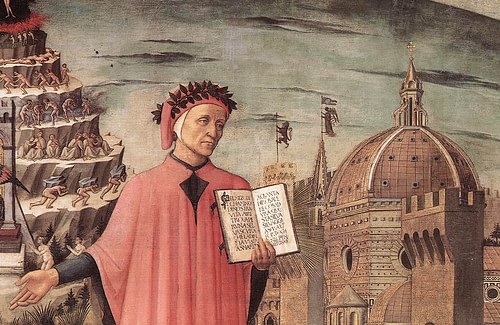
Dante, Florence Cathedral
The teachings of the Church building were a certainty to the people of the Middle Ages. There was no room for incertitude, and questions were non tolerated. One was either in the Church or out of information technology, and if out, one's interactions with the residue of the community were limited. Jews, for example, lived in their ain neighborhoods surrounded by Christians and were regularly treated quite poorly. The French male monarch Charles Martel (r. 718-741), defeated the Muslim invasion of Europe at the Battle of Tours (also known equally the Battle of Poitiers, 732), and and then Muslims in Europe were rare at this time outside of Spain and the traveling merchants conducting merchandise. A citizen of Europe, therefore – who did not vest to either of these faiths – had to attach to the orthodox vision of the Church building in gild to interact with family, customs, and make a living. If i constitute ane could not do so (or at least appear to practice then), the only option was a then-called heretical sect.
Corruption & Heresy
The heretical sects of the Middle Ages were uniformly responses to the clear corruption and greed of the Church building. The immense wealth of the Church, accrued through tithes and lavish gifts, only inspired a desire for even greater wealth which translated every bit ability. An archbishop could, and frequently did, threaten a noble, a boondocks, or fifty-fifty a monastery with excommunication – by which ane was exiled from the Church and then from the grace of God and commerce with fellow citizens – for whatsoever reason. Even well-known and devout religious figures – such as Hildegard of Bingen (l. 1098-1179) – were subject to 'discipline' along these lines for disagreeing with an ecclesiastical superior.
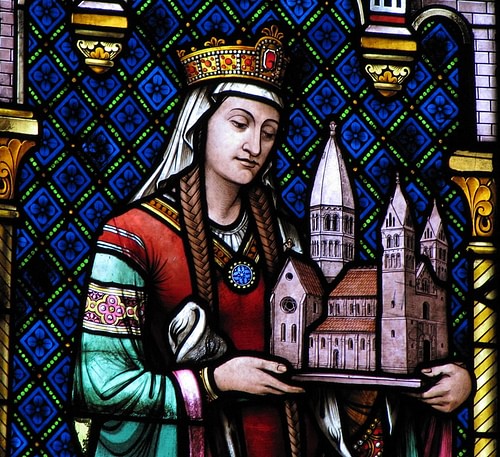
Depiction of Hildegard of Bingen in the St. Foy Church
The priests were notoriously decadent and, in many cases, illiterate parasites who only held their position due to family influence and favor. Scholar G. K. Coulton cites a letter of 1281 in which the writer warns how "the ignorance of the priests precipitates the people into the ditch of fault" (259) and later cites the correspondence of one Bishop Guillaume le Marie de Angers, who writes:
The Priesthood includes innumerable contemptible persons of abject life, utterly unworthy in learning and morals, from whose execrable lives and pernicious ignorance space scandals ascend, the Church building sacraments are despised past the laity, and in very many districts the lay folk hold the priests equally [vile]. (259)
The medieval mystic Margery Kempe (fifty. C. 1342-1438) challenged the wealthy clerics to reform their corruption while, almost 200 years before, Hildegard of Bingen had done the same as had men like John Wycliffe and January Hus. The Church was not interested in reform, however, considering it had the last discussion on any subject field equally God'due south vocalism on globe.
Those who found the abuses of the Church building as well intolerable and were seeking an honest spiritual experience instead of an unending pay-to-pray scheme, which non even death could halt, joined religious sects outside the Church and attempted to live peacefully in their own communities. The best-known of these were the Cathars of Southern France who, while they interacted with the Cosmic communities they lived near or in, had their own services, rituals, and belief arrangement.
These kinds of communities were routinely condemned by the Church and destroyed, their members massacred, and any lands they had confiscated as Church belongings. Even an orthodox community which adhered to Cosmic teachings – such every bit the Beguines – was condemned because it was begun spontaneously as a response to the needs of the people and was not initiated past the Church. The Beguines were laywomen who lived as nuns and served their customs, belongings all possessions in common and living a life of poverty and service to others, but they were non approved by the Church building and were therefore condemned; they were disbanded along with their male counterparts, the Beghards, in the twelfth century.
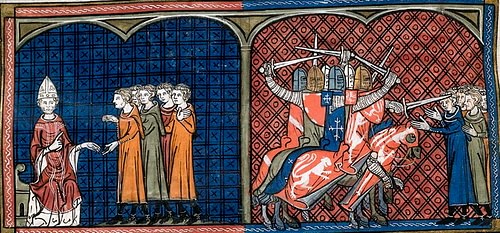
Pope Innocent 3 & the Albigensian Crusade
These groups, and others like them, attempted to affirm spiritual autonomy based on the scriptural authority of the Bible, without any of the Church's trappings or elaborate ritual. The Cathars believed that Christ never died on the cross and was therefore never resurrected but that, instead, the son of God had been spiritually offered for the sins of humanity on a higher plane. The gospel stories, they claimed, should be understood equally allegories using symbolic language rather than static histories of a past event. They further advocated for the feminine principle in the divine, revering a goddess of wisdom known as Sophia, to whom they devoted their lives.
Living merely and serving the surrounding customs, the Cathars clustered no wealth, their priests owned nothing and were highly respected equally holy men fifty-fifty by Catholics, and Cathar communities offered worthwhile goods and services. The Beguines, while never claiming any beliefs exterior of orthodoxy, were equally devout and selfless in their efforts to help the poor and, particularly, poor single mothers and their children. Both of these movements, however, offered people an alternative to the Church, and the medieval Church found that intolerable. Any change in people's attitudes toward faith threatened the ability of the Church, and the Church had enough power to beat such movements even in cases where sects such as the Cathars had significant support and protection.
Reformation
John Wycliffe and his followers (known as Lollards) had been calling for reformation since the 14th century, and information technology might be difficult for a modern-day reader to fully understand why no serious attempts were made at reform, simply this is simply considering the modern era offers so many different legitimate avenues for religious expression. In the Eye Ages, it was inconceivable that at that place could exist any valid belief system other than the Church.
Heaven, hell, and purgatory were all very real places to the people of the Centre Ages, and ane could not run a risk offending God by criticizing his Church and damning i'southward self to an eternity of torment in a lake of fire surrounded by demons. The wonder is not so much why more people did non phone call for reform every bit that anyone was brave enough to try.
The Protestant Reformation did not arise as an attempt to overthrow the power of the Church building but began only every bit yet another try at reforming ecclesiastical abuse and corruption. Martin Luther (fifty. 1483-1546) was a highly-educated German priest and monk who moved from concern to outrage over the abuses of the Church building. Martin Luther's 95 Theses (1517) famously criticized the auction of indulgences as a coin-making scheme having no biblical authority and no spiritual worth and opposed the Church'southward teachings on a number of other matters.

Martin Luther
Luther was condemned by Pope Leo 10 in 1520 who demanded he renounce his criticism or face excommunication. When Luther refused to recant, Pope Leo moved ahead with the excommunication in 1521, and Luther became an outlaw. Like Wycliffe, Hus, and others before him, Luther was simply stating the obvious in calling for an finish to rampant abuse and abuse. Like Wycliffe, he translated the Bible from Latin into the vernacular (Wycliffe from Latin to Heart English and Luther from Latin to German), opposed the concept of sacerdotalism whereby a priest is necessary as an intermediary between a believer and God, and maintained that the Bible and prayer were all one needed to district direct with God. In making these claims, of grade, he not only undermined the authorization of the Pope but rendered that position – as well equally those of the cardinals, bishops, archbishops, priests, and others – ineffectual and obsolete.
According to Luther, salvation was granted by the grace of God, not by the expert deeds of homo beings, so all of the works the Church required of people were of no eternal use and just served to fill the Church's treasury and build their grand cathedrals. Attributable to the political climate in Germany, and Luther's own charisma and intelligence, his effort at reform became the motion which would break the power of the Church. Other reformers such as Huldrych Zwingli (l. 1484-1531) and John Calvin (l. 1509-1564) broke new ground in their own regions and many others followed suit.
Decision
The monopoly the Church held on religious conventionalities and do was broken, and a new era of greater spiritual freedom was begun, but it was non without cost. In their zeal to throw off the oppression of the medieval Church, the newly liberated protestors destroyed monasteries, libraries, and cathedrals, the ruins of which still dot the European landscape in the present day.
The Church had certainly become increasingly decadent and oppressive and its clergy was oftentimes characterized far more by a love of worldly goods and pleasures than spiritual pursuits but, at the same time, the Church building had initiated hospitals, colleges and universities, social systems for the care of the poor and the sick, and maintained religious orders which allowed women an outlet for their spirituality, imagination, and ambitions. These institutions became especially important during the Black Expiry pandemic of 1347-1352 which killed millions of people in Europe and significantly impacted people'due south faith in the vision of the Church.
The Protestant Reformation, unfortunately, destroyed much of the good the Church had done in reacting to the abuse it had fallen into and its perceived failure to come across the challenge of the plague outbreak. Somewhen, the different movements would organize into the Christian Protestant sects recognizable today – Lutherans, Presbyterians, Episcopalians, and so on – and set their own institutes of higher learning, hospitals, and social programs. When the Reformation began, there was only the Church, the monolithic powerhouse of the Centre Ages, which afterwards became simply one option for religious expression amongst many.
This commodity has been reviewed for accuracy, reliability and adherence to academic standards prior to publication.
alexanderyousaity1990.blogspot.com
Source: https://www.worldhistory.org/Medieval_Church/
0 Response to "Influence the Church Have Over Art in the Middle Ages"
Post a Comment